Viking Refrigerator Cooling Unevenly: Warm Fridge, Cold Freezer
A fresh-food side creeping into the fifties while the freezer stays rock hard is not a dying compressor. It is airflow, and there are four places it stops — here is how to tell which one, and what Phoenix heat has to do with it.
A Viking refrigerator with a warm fresh-food compartment and a freezer that is still hard is one of the most misread faults in the kitchen. People hear “not cooling”, assume the expensive part, and start pricing replacements. The symptom is actually good news: the cold is being made. It is simply not arriving where it is needed.
That distinction is worth understanding before anyone quotes you anything, because it rules out the sealed system almost entirely and narrows the problem to four candidates that share one theme — air that has stopped moving.
Why one compartment can fail on its own
Built-in and column refrigeration makes cold in one place. A single evaporator coil sits behind a panel, usually in the freezer section, and an evaporator fan pushes air across it and then distributes that air between the two compartments through ducts and a damper.
The freezer is closest to the source. The fresh-food side is at the end of the delivery route. So anything that interrupts the airflow starves the fridge first and the freezer last — which is exactly the pattern you are looking at.
A compressor problem cannot produce that pattern. If refrigerant or compression were the issue, both compartments would drift up together, slowly and evenly. One side holding while the other climbs is a distribution fault by definition.
The four faults behind a warm fresh-food side
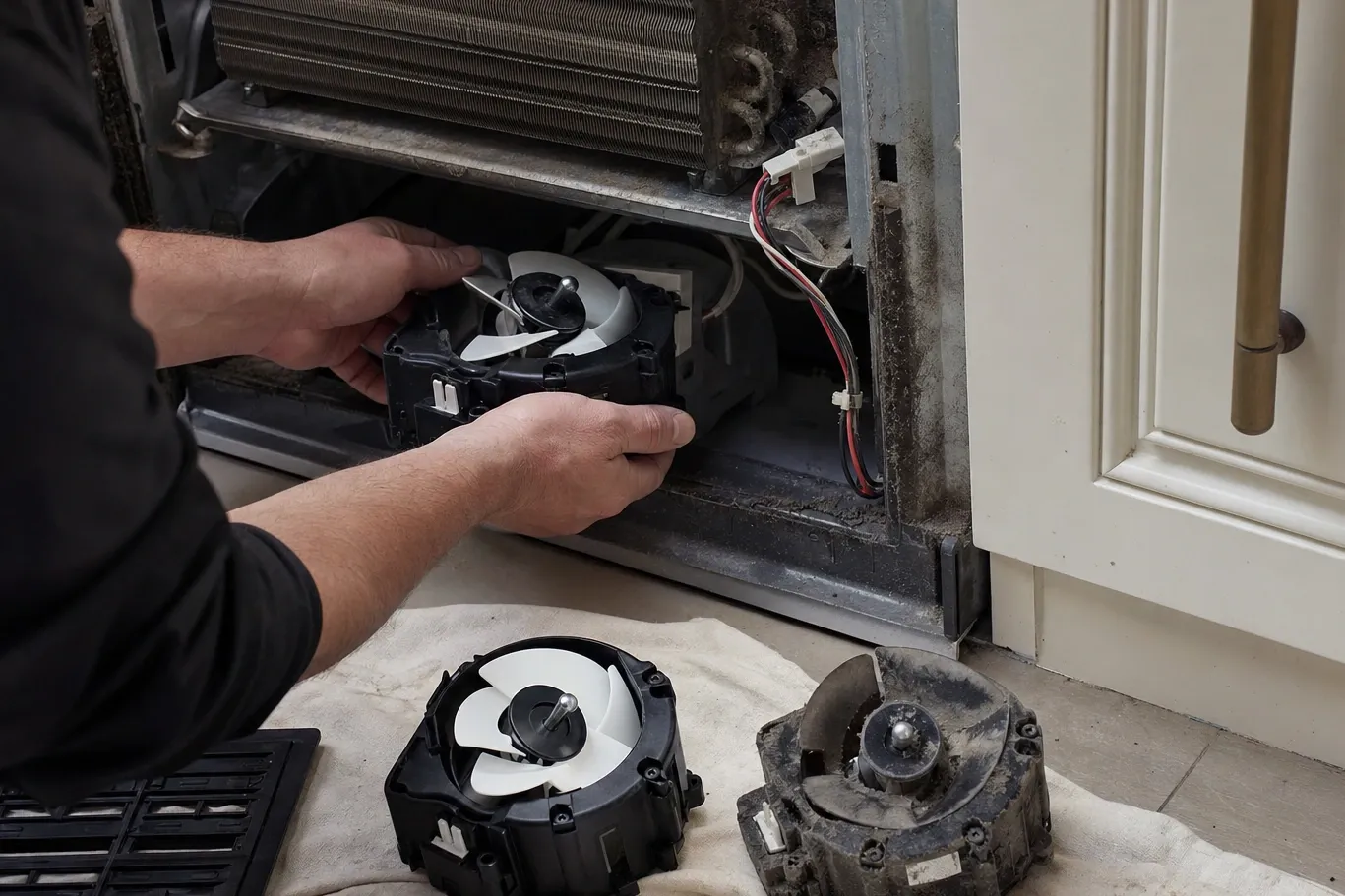
The evaporator fan has stalled. A motor that has run for a decade in a cold, occasionally damp environment eventually seizes or slows. Sometimes the blade has shifted on the shaft and is catching its shroud — you can often hear that as a rhythmic tick or a drone that comes and goes with the door switch. No fan, no delivered air.
The defrost system has stopped running. Every so often a heater melts the frost that builds on the evaporator. When the heater, the thermostat or the timer fails, ice keeps accumulating until it fills the space the air is supposed to move through. The tell is a freezer that stays perfectly cold for a while and a fridge that gets progressively worse over days rather than hours.
The air damper is stuck or unseated. The damper is a small motorised flap that meters cold air into the fresh-food side. Stuck shut, that compartment starves. Stuck open, it over-cools and the freezer suffers instead. These get knocked out of position during cleaning or after a previous repair far more often than they fail electrically.
Warm air is being pulled in. A door gasket that has gone hard, a door that no longer sits square on its hinges, or an interior light staying on behind a closed door will all load the compartment with heat the ducting was never sized for. The light one is worth checking first because it costs nothing to find.
What Phoenix does to a condenser
Three local conditions make refrigeration fail here in ways it does not in milder climates.
The first is dust. Fine desert dust packs the condenser coil and the fins around it until the cabinet can no longer shed heat. A condenser that cannot reject heat runs the compressor continuously, and a compressor that never cycles off runs hot enough to shorten everything around it. This is the single most common thing we find on a first visit.
The second is the garage. A second refrigerator out there is standard in this metro, and by July that space runs far above the ambient temperature the cabinet was designed for. Past roughly 110°F the machine is simply outside its envelope. The component that usually gives up first is the condenser fan motor, not the compressor — which is fortunate, because it is a fraction of the work.
The third is water. City water in the older central districts is hard enough to scale a filter housing and crack it, and to fur up an ice maker’s fill valve within a few years. Neither causes a warm fridge on its own, but both turn up during the same visit often enough to be worth mentioning on the phone.
What you can check safely
Do these before you book anything. They cost nothing and two of them occasionally solve the problem outright.
- Put a glass of water in the middle of the fresh-food side, leave it four hours, then read a thermometer in it. Cabinet displays are averaged and smoothed; a glass of water is not.
- Open the door and listen. You should hear the evaporator fan spin up and settle. Silence, or a scraping note, is a finding in itself.
- Press the door switch with the door open and watch the interior lamp. If it stays lit, you have found a heat source that runs all night.
- Pull the base grille and look at the condenser coil. If you cannot see through the fins, that is your first job regardless of what else is wrong.
- Look at the back wall inside the freezer. An even light frost is normal. A solid sheet, or ice creeping across the ceiling and down the drawer fronts, points at defrost.
What not to do: do not turn the thermostat colder to compensate. It does not increase airflow, it just runs the compressor longer, and on a defrost fault it accelerates the icing that caused the problem in the first place.
When it is worth calling
Call once the fresh-food side has been above 45°F for a few hours and none of the checks above has explained it. Bring three things to the conversation: the model number from the rating plate inside the door frame, the water-glass reading from both compartments, and whether the fan is audible. Those three facts usually narrow the fault to one or two candidates before anyone drives, which decides whether an evaporator fan, a defrost heater or a damper assembly comes on the van.
Where it stops being an owner’s job is the moment the evaporator panel has to come off. Behind it sit the heater, the sensor and a coil that is genuinely easy to puncture, and a puncture turns a straightforward airflow repair into a sealed-system job. That is the line worth respecting.
Follow-up questions
- Is a warm fridge and a cold freezer a sign the compressor is going?
- Almost never. A failing compressor takes both compartments down together, because there is only one cold source in the cabinet. When one side is fine and the other is not, the cold is being made and then not delivered — which points at a fan, a defrost fault or a blocked air path, all of them far cheaper than a sealed-system repair.
- How long should I leave it before calling?
- If the fresh-food side is above 45°F for more than a few hours, move the perishables and stop waiting. Cycling the power or turning the dial colder will not fix an airflow fault, and on a defrost failure every extra day builds more ice around the evaporator, which makes the eventual visit longer rather than shorter.
- Does the temperature outside really change how a built-in refrigerator behaves?
- Yes, and more here than almost anywhere. These cabinets are rated to work in a room, and a Phoenix garage in July is not a room. Above roughly 110°F the condenser cannot shed heat quickly enough, the compressor stops cycling off, and the first component to give up is usually the condenser fan motor.
- Why is there frost on the back wall inside the freezer?
- A light even coat is normal and gets cleared by every defrost cycle. A thick sheet, or frost that keeps coming back in the same spot, means either the defrost system is not running or warm humid air is getting in past a seal. Both are repairs, and the second one is often just a hardened gasket.